'The World's Largest Dinosaurs' Opens at the Denver Museum of Nature & Science on March 20
PR Newswire
DENVER, March 9, 2026
DENVER, March 9, 2026 /PRNewswire/ -- The Denver Museum of Nature & Science has announced its newest exhibition, "The World's Largest Dinosaurs," which explores the biology and anatomy of sauropods — the largest land animals to ever walk the Earth. The temporary exhibition opens to the public on Friday, March 20, 2026, and will run through Monday, Sept. 7, 2026.
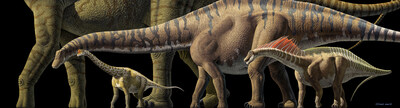
"The World's Largest Dinosaurs" invites visitors to explore one of the most fascinating questions in paleontology — how any animals could grow and survive at such an extraordinary size," said Dr. Patrick O'Connor, director of Earth & Space Sciences at the Denver Museum of Nature & Science. "By pairing scientific discovery with interactive experiences—like seeing a sauropod's beating heart projected onto a 60-foot model or assembling giant skeletons through magnetic puzzles—this exhibition makes the extraordinary biology of these ancient giants both captivating and genuinely accessible to visitors of all ages."
Presented in the Phipps Gallery on the Museum's third floor, this family-friendly exhibition takes visitors inside the colossal bodies of sauropod—the long-necked, long-tailed, plant-eating dinosaurs that ranged from 15 to 150 feet long and weighed an average of 12 tons. Through life-sized bones, organs, interactive displays and multimedia experiences, guests will discover how heart rate, respiration, digestion and metabolism are all linked to size. At the center of the exhibition, visitors will come face-to face with a 60-foot-long model of Mamenchisaurus, famous for its remarkable 30-foot-long neck.
Details and Highlights:
- A dramatic introduction featuring the massive head of Argentinosaurus, one of the largest dinosaurs ever discovered
- A life-sized, fleshed-out model of a 60-foot-long Mamenchisaurus, with internal organs revealed and animated projections illustrating how its body functioned
- Interactive stations exploring how sauropods ate, breathed, circulated blood and fueled their enormous bodies
- Displays showing how hatchlings weighing less than 11 pounds grew to become 55-ton adults
- An exclusive showcase of the Museum's own collection, including the very first dinosaur bone the Museum ever collected, which was a sauropod, and a 40-foot section of a sauropod tail along with two shoulder blade bones measuring 8-feet long each
- A special look at ongoing and future research focused on this group of dinosaurs by Museum scientists and their collaborators around the world
"The World's Largest Dinosaurs" is open to Museum members and general admission ticketholders alike; an additional exhibition ticket is required.
"The World's Largest Dinosaurs" is organized by the American Museum of Natural History, New York (amnh.org).
About the Denver Museum of Nature & Science
The Denver Museum of Nature & Science is the Rocky Mountain region's leading resource for formal and informal science education. Many of the Museum's educational programs and exhibits are made possible in part by the citizens of the seven-county metro area through the Scientific & Cultural Facilities District. The Museum is accredited by the American Alliance of Museums. Connect with the Museum on Facebook, Instagram, TikTok and Catalyst.
About the American Museum of Natural History (AMNH)
The American Museum of Natural History in New York City, founded in 1869 with a dual mission of scientific research and science education, is one of the world's preeminent scientific, educational, and cultural institutions. The Museum encompasses more than 40 permanent exhibition halls, galleries for temporary exhibitions, the Rose Center for Earth and Space including the Hayden Planetarium, and the Richard Gilder Center for Science, Education, and Innovation. The Museum's scientists draw on a world-class permanent collection of more than 30 million specimens and objects, some of which are billions of years old, and on one of the largest natural history libraries in the world. Through its Richard Gilder Graduate School, the Museum offers two of the only free-standing, degree-granting programs of their kind at any U.S museum: the Ph.D. program in Comparative Biology and the Master of Arts in Teaching (MAT) Earth Science residency program. Visit amnh.org for more information.
CONTACT: Maura O'Neal, publicrelations@dmns.org, 303-507-6058
 View original content to download multimedia:https://www.prnewswire.com/news-releases/the-worlds-largest-dinosaurs-opens-at-the-denver-museum-of-nature--science-on-march-20-302708354.html
SOURCE Denver Museum of Nature & Science


